
There’s something almost magical about pulling a perfectly roasted boneless prime rib from the oven, its exterior a deep mahogany brown while the interior stays pink and tender all the way through. This cut represents the best of what beef has to offer: marbling, tenderness, and enough flavor to make you forget every steak you’ve ever had.
A boneless prime rib is special because it delivers restaurant-quality results without the intimidation factor of a bone-in roast. You get all the luxurious, buttery texture and rich flavor in a package that’s easier to carve and portion.
What makes this recipe stand out is the simplicity paired with technique: a dry brine that seasons the meat deep inside, a hot sear for a flavorful crust, and a gentle roast to a perfect medium-rare. The result is a showstopping centerpiece that tastes like you spent hours fussing, when really you just understood the fundamentals.
Why You’ll Love This Recipe
This boneless prime rib recipe delivers tender, juicy meat with a flavorful crust and minimal hands-on work. Once you nail this technique, you’ll have a go-to method for impressing guests or treating yourself to something truly special.
- Restaurant-quality results from your home kitchen with minimal technique required
- Dry brine method seasons the meat thoroughly from edge to center
- Reverse sear approach gives you a perfect edge-to-edge cook without overcooking
- Serves 6 to 8 people, making it ideal for holidays or special dinners
- Leftovers (if you have them) make incredible sandwiches and roast beef applications
My Experience Making This Recipe
I’ve made this roast at least a dozen times, and each one teaches me something new. The first time, I skipped the dry brine thinking salt would make the meat tough, and I was dead wrong: the surface dried out instead of browning properly, and the interior lacked depth.
After switching to the dry brine method, everything changed. The meat took on a deep, savory crust, and when I sliced into it, every bite was tender and juicy with seasoning throughout, not just on the surface.
My guests have ranged from steak snobs to people who claim they don’t like beef that much, and I haven’t encountered a single person who didn’t come back for seconds. There’s something about a properly cooked prime rib that converts skeptics.
Recipe Overview
- Recipe Name: Boneless Prime Rib
- Servings: 6 to 8 people
- Prep Time: 15 minutes plus 24 to 48 hours dry brining
- Cook Time: 2 to 2.5 hours
- Total Time: 24 to 48 hours (mostly passive)
- Course: Main
- Cuisine: American
- Calories per Serving: 485
Equipment You Will Need
- Instant-read meat thermometer (essential for accuracy)
- Large rimmed baking sheet or roasting pan
- Cast iron skillet or oven-safe heavy-bottomed pan
- Paper towels
- Sharp carving knife
- Oven racks positioned in middle and lower-middle spots
- Meat tongs or kitchen fork
Ingredients for Boneless Prime Rib
- Boneless prime rib roast: 4 to 5 pounds (about 2 inches thick)
- Kosher salt: 2 tablespoons
- Black pepper: 1.5 teaspoons, freshly cracked
- Garlic powder: 1 teaspoon
- Dried thyme: 0.5 teaspoon
- Dried rosemary: 0.5 teaspoon
- Vegetable oil: 2 tablespoons (for searing)
- Butter: 2 tablespoons
- Fresh garlic cloves: 3, smashed
- Fresh thyme sprigs: 2 for basting (optional but recommended)
Ingredient Notes and Substitutions
- Boneless prime rib roast: This cut comes from the rib section and has beautiful marbling that keeps the meat tender and juicy during cooking. If you can’t find prime grade, choice grade works fine, though the flavor will be slightly less rich.
- Kosher salt: Its larger crystals let you season more evenly than table salt. Sea salt works in a pinch, though use slightly less since it’s denser.
- Freshly cracked black pepper: Pre-ground pepper loses flavor quickly and tastes dusty compared to freshly cracked peppercorns. Use a pepper mill for the best result.
- Garlic powder and dried herbs: These intensify as the meat cooks, creating a savory crust without overpowering the beef. Fresh herbs can substitute in the basting butter, though dried herbs distribute more evenly in the salt rub.
- Vegetable oil: Any neutral oil with a high smoke point works; avocado oil and refined coconut oil are good alternatives.
How to Make Boneless Prime Rib
Step 1: Apply the Dry Brine
Remove your boneless prime rib from the fridge and place it on a large cutting board. Mix the kosher salt, black pepper, garlic powder, thyme, and rosemary in a small bowl, then rub this mixture all over the meat, making sure to coat the top, bottom, and sides evenly.
This dry brine does two important things: the salt penetrates deep into the meat over 24 to 48 hours, seasoning it throughout (not just the surface), and it pulls moisture out initially, which then reabsorbs and keeps the meat incredibly juicy. Don’t skip this step or rush it; the longer it sits, the better the flavor.
Step 2: Place on a Rack and Refrigerate
Transfer the seasoned roast to a wire rack set over a rimmed baking sheet, then place it uncovered in the refrigerator for 24 to 48 hours. The rack is crucial here: it lets air circulate around the entire roast, allowing the surface to dry out and become tacky, which is exactly what you want for a good sear.
The longer it sits, the better the crust will develop. If you only have 12 hours, that works, but 24 to 48 hours is ideal.
Step 3: Let the Roast Come to Room Temperature
Remove the roast from the fridge about 2 hours before cooking and let it sit at room temperature on the counter. This ensures the meat cooks evenly from edge to center instead of having a cold center that takes forever to reach temperature while the outside overcooks.
You’ll notice the surface has become even more dry and slightly leathery; this is perfect for developing a deep brown crust.
Step 4: Preheat Your Oven
Set your oven to 225 degrees Fahrenheit and let it preheat fully for about 15 minutes. A low oven temperature is the secret to even cooking: it raises the internal temperature slowly and gently, giving you a large band of perfectly pink meat without a gray, overcooked ring underneath the crust.
Use an oven thermometer to verify the temperature, since many ovens run hot or cold.
Step 5: Sear the Roast
Heat a cast iron skillet or heavy-bottomed oven-safe pan over medium-high heat until it’s smoking hot. Add the vegetable oil and swirl to coat the pan, then carefully place the roast fat-side down into the pan and let it sear for 3 to 4 minutes without moving it.
Flip the roast and sear the other side, the ends, and any exposed edges for 2 to 3 minutes each, until the entire exterior is a deep golden-brown color. This Maillard reaction creates the flavorful, savory crust that makes prime rib so satisfying. Don’t rush this: if the pan isn’t hot enough, you’ll steam the meat instead of searing it.
Step 6: Set Up for the Low-Temperature Roast
Transfer the seared roast to a roasting pan and insert an instant-read thermometer into the thickest part of the meat, making sure it doesn’t touch bone or the bottom of the pan. Add the smashed garlic cloves and fresh thyme sprigs to the pan around the roast.
This setup is critical: the thermometer lets you monitor progress without opening the oven repeatedly, and the aromatics in the pan will add subtle flavor to any pan juices.
Step 7: Roast at Low Temperature
Place the roast in your 225-degree oven and roast until the thermometer reads 115 to 120 degrees Fahrenheit for medium-rare, about 2 to 2.5 hours depending on the thickness and your oven. Resist the urge to peek; every time you open the oven, you lose heat and extend the cooking time.
The meat will continue to cook 5 to 10 degrees as it rests, so pulling it at 120 degrees ensures it reaches a perfect 125 to 130 degrees (the target for medium-rare) once it’s rested.
Step 8: Baste with Butter and Rest
Once the roast reaches 115 to 120 degrees, melt the butter in a small saucepan and tilt the roasting pan so the juices pool on one side. Spoon the melted butter over the roast and baste it several times, then remove it from the oven and transfer it to a clean cutting board.
Tent it loosely with foil and let it rest for 15 to 20 minutes. This resting period lets the juices redistribute throughout the meat instead of running all over your cutting board when you slice it, keeping every bite moist and tender.
Step 9: Slice and Serve
Using a sharp carving knife, slice the roast against the grain into half-inch to three-quarter-inch thick slices. Serve immediately with the pan juices spooned over the top, or pass them on the side in a warm gravy boat.
Arrange the slices on a warm platter and garnish with any crispy garlic bits and fresh herb sprigs if desired.
Pro Tip: An instant-read thermometer is non-negotiable for this recipe: it removes the guesswork and ensures you pull the roast at the exact right moment, giving you perfect edge-to-edge doneness every time.
Tips for the Best Boneless Prime Rib
- Buy a roast with good visible marbling and a thick fat cap on top. This fat bastes the meat from above as it cooks and adds incredible flavor.
- Don’t skip the dry brine step or shorten it. The salt really does change everything, seasoning the meat deeply and creating a better crust.
- Use an oven thermometer to verify your oven’s actual temperature. Many home ovens are off by 25 degrees or more, which throws off cook time significantly.
- Let the roast come completely to room temperature before cooking. A cold center will either end up overcooked on the outside or underdone inside.
- Invest in a good instant-read thermometer. Guessing by time or color is how people end up with either dry or raw prime rib.
- Tent the roast loosely with foil during resting, not tightly. Tight foil traps steam and makes the crust soggy.
Common Mistakes to Avoid
- Skipping the dry brine because you think salt dries out meat. This misconception causes more failed prime ribs than any other mistake; salt actually helps the meat retain moisture by changing how proteins hold water.
- Cooking at too high a temperature throughout. High heat gives you a nice crust but forces you to pull the roast early to avoid overcooking the inside, resulting in a small band of pink surrounded by gray meat.
- Not using a thermometer and relying on cooking time instead. Roasts vary in thickness, shape, and how your oven distributes heat, so time is unreliable.
- Cutting into the roast to check doneness while it cooks. This lets precious juices escape and makes it impossible to get an accurate reading of the actual temperature.
- Skipping the resting period to serve immediately. The meat is too hot and the juices haven’t redistributed yet, so when you cut it, they run onto the plate instead of staying in the meat.
Serving Suggestions
A perfectly cooked boneless prime rib needs accompaniments that complement its richness without overshadowing it. Think classic steakhouse sides that let the beef be the star while adding texture and brightness to the plate.
- Creamed spinach with garlic and a hint of nutmeg for richness and color contrast
- Roasted potatoes tossed with rosemary, thyme, and crispy garlic for earthy comfort
- Horseradish cream sauce to cut through the richness and add sharp, clean flavor
- A simple green salad with Dijon vinaigrette and shallots for acidity and freshness
- Grilled asparagus with lemon butter and parmesan for elegance and a hint of brightness
Variations to Try
- Garlic and Herb Crusted: Press finely minced fresh garlic, parsley, and thyme into the rub before the dry brine, creating an herbaceous, aromatic crust with more freshness than dried herbs alone.
- Coffee-Rubbed Prime Rib: Add 1 teaspoon of finely ground espresso powder to the salt rub for depth and a subtle earthiness that amplifies the beef’s savory notes without tasting like coffee.
- Truffle Oil Finish: Drizzle a bit of truffle oil over the sliced roast just before serving for an indulgent, luxurious touch that makes it even more decadent.
- Asian-Inspired Version: Replace the dried herbs with ginger, five-spice powder, and a touch of soy sauce mixed into the rub for a completely different flavor profile that’s still delicious.
- Smoked Prime Rib: Sear the roast, then finish it in a smoker at 225 degrees instead of an oven, using oak or hickory wood for a subtle smoky flavor that complements beef beautifully.
Dietary Adaptations
- Gluten-Free: This recipe is naturally gluten-free as written; just verify your spices and salt have no additives, which is standard for pure kosher salt and dried herbs.
- Dairy-Free: Skip the butter basting step or substitute with a high-heat oil like avocado oil, though you’ll lose some of the rich, luxurious flavor that butter brings.
- Paleo/Whole 30: This recipe fits perfectly into both diets with no modifications; just ensure your spices are free of additives.
- Low-Carb/Keto: Prime rib is ideal for keto since it’s pure protein and fat with zero carbs; serve it with keto-friendly sides like cauliflower mash or butter-roasted vegetables.
Storage and Reheating
Refrigerator
Slice any leftovers and store them in an airtight container with any pan juices for up to 4 days. The juices keep the meat from drying out and add flavor when you reheat.
- Place slices in a container with pan juices or a thin layer of beef broth
- Cover tightly with foil or an airtight lid
- Store on a middle shelf, not the door, for consistent temperature
Freezer
Wrap sliced leftovers tightly in plastic wrap, then aluminum foil, and freeze for up to 3 months. The double wrapping protects against freezer burn.
- Label with the date before freezing
- Thaw overnight in the refrigerator before reheating
- Frozen pan juices can be frozen separately in ice cube trays for easy portioning
Reheating
Reheat sliced prime rib gently in a 300-degree oven covered with foil for about 10 to 15 minutes until warmed through. Avoid the microwave, which dries out the meat unevenly.
- Arrange slices in a baking dish with a little pan juice or broth on the bottom
- Cover tightly with foil to trap steam
- Check that the internal temperature reaches 130 degrees before serving
- For a quicker method, reheat gently in a skillet over low heat with a splash of pan juice, turning occasionally
Nutrition Information
| Nutrient | Amount |
|---|---|
| Calories | 485 |
| Total Fat | 38g |
| Saturated Fat | 15g |
| Carbohydrates | 0g |
| Fiber | 0g |
| Sugar | 0g |
| Protein | 48g |
| Sodium | 380mg |
| Cholesterol | 125mg |
These values are approximate and calculated based on 8 servings from a 4.5-pound roast cooked to medium-rare. Values will vary slightly depending on the exact weight of your roast and how much fat you trim before cooking.
Frequently Asked Questions
Can I make this prime rib without a thermometer?
Technically yes, but you’ll be guessing, and guessing usually ends badly. A good instant-read thermometer costs around 15 to 20 dollars and removes all the stress from cooking expensive meat.
What’s the difference between prime rib and ribeye?
Prime rib is a large roast cut from the rib section, while a ribeye is a single steak cut from the same primal but much thinner. Prime rib’s larger size and longer cooking time result in a different texture and juice distribution than a quick-seared ribeye.
Can I cook this ahead and reheat it for a dinner party?
Yes, cook it completely the day before, let it cool, slice it, and store it in the fridge with pan juices. Reheat gently in a 300-degree oven covered with foil until warm, which takes about 15 minutes.
Why is my roast coming out dry even though the thermometer says medium-rare?
The most likely culprit is skipping the dry brine step or rushing it. Salt takes time to penetrate and do its magic; without it, the meat loses moisture and comes out mealy and dry no matter what temperature you pull it at.
Is boneless prime rib cheaper than bone-in, and is it worth it?
Boneless is often slightly cheaper since the butcher removes the bone. It’s worth buying whichever is fresher and has better marbling, since the bone doesn’t add much flavor in a low-and-slow roast like this one.
Can I use a different rub or glaze?
Absolutely; this recipe’s simple rub is just a starting point. Any seasoning blend that works for beef will work here, from Montreal steak seasoning to a coffee-espresso rub to a peppercorn crust.
Final Thoughts
Making a boneless prime rib at home is far easier than most people think, and the results rival or beat any restaurant version you’ve had. The key is patience: let the salt work its magic, let the roast come to room temperature, and let it rest after cooking.
Once you’ve made this once and tasted how good it is, you’ll find yourself making it again and again, probably for every special occasion worth celebrating. Your guests will remember it, and honestly, so will you.
If you’re looking for more showstopping main courses to master, check out our sirloin tip roast recipe for another impressive beef centerpiece, or explore our steak burrito recipe for a fun way to use leftover sliced beef. Both are family favorites that deliver big flavor without the fuss.
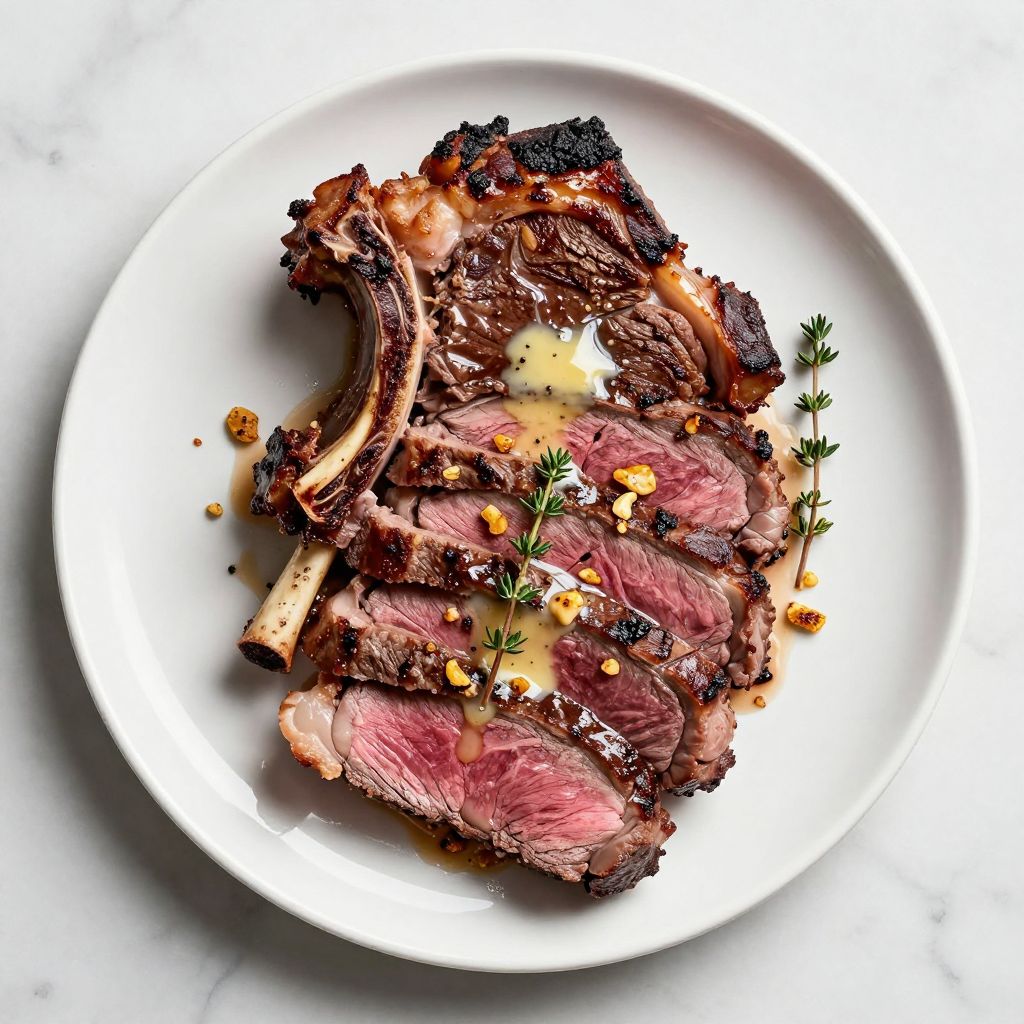
Boneless Prime Rib
Ingredients
Equipment
Method
- Mix kosher salt, black pepper, garlic powder, dried thyme, and dried rosemary in a small bowl and rub evenly over all surfaces of the roast.
- Place the seasoned roast on a wire rack set over a rimmed baking sheet and refrigerate uncovered for 24 to 48 hours.
- Remove the roast from the refrigerator 2 hours before cooking and let it come to room temperature.
- Preheat the oven to 225°F and position racks in the middle and lower-middle spots.
- Heat a cast iron skillet over medium-high heat until smoking, add vegetable oil, then sear the roast fat-side down for 3 to 4 minutes. Flip and sear the other sides for 2 to 3 minutes each.
- Transfer the roast to a roasting pan, insert an instant-read thermometer into the thickest part of the meat, and add smashed garlic cloves and fresh thyme sprigs around the roast.
- Roast in the preheated 225°F oven until the internal temperature reaches 115 to 120°F, about 2 to 2.5 hours.
- Melt butter in a small saucepan, tilt the roasting pan to collect pan juices, spoon the melted butter over the roast, then remove the roast and tent loosely with foil. Rest for 15 to 20 minutes.
- Slice the roast against the grain into 1/2- to 3/4-inch thick slices and serve immediately with pan juices spooned over the top.