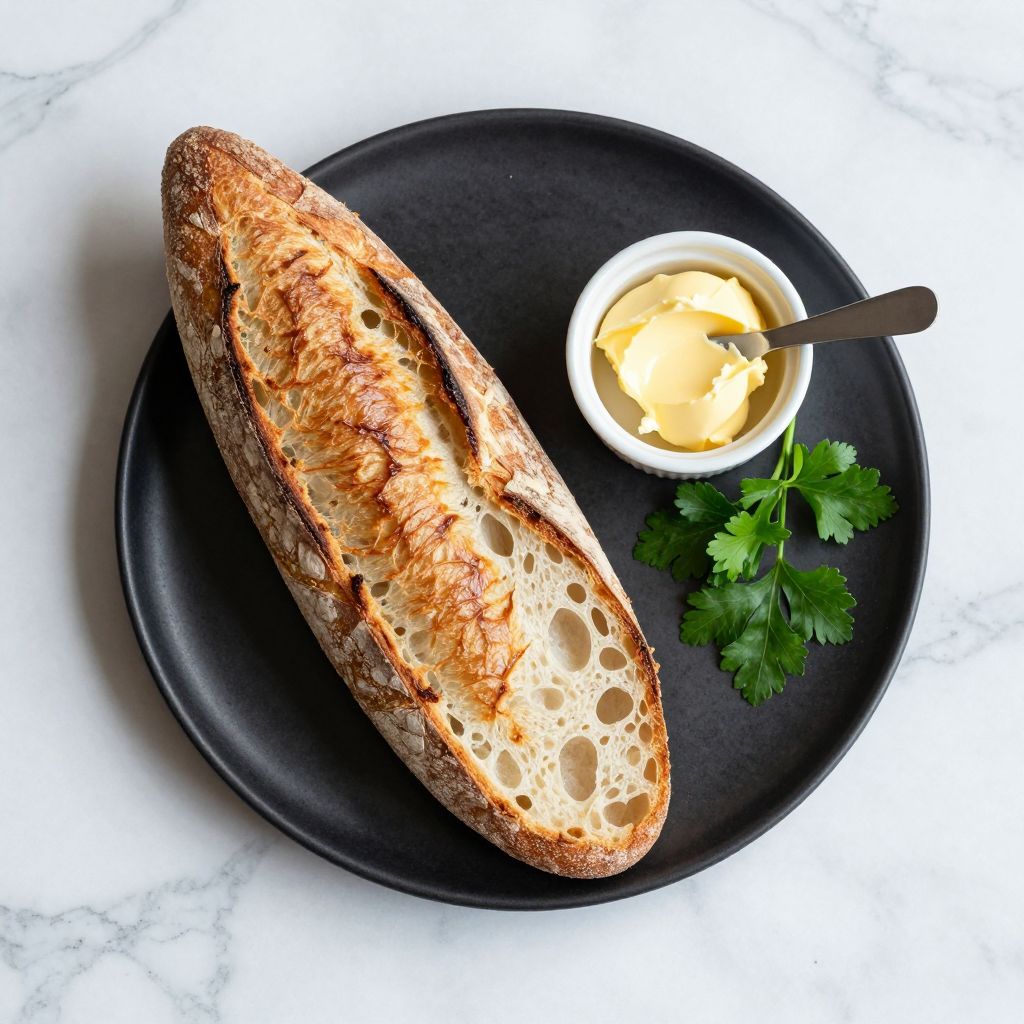
Ingredients
Equipment
Method
- Build the Levain: Mix 25 grams of active starter with 50 grams each of bread flour and room temperature water in a small jar. Cover loosely and let it ferment at room temperature for 4 to 6 hours until doubled and bubbly. The levain is ready when it floats in water.
- Autolyse the Flour and Water: Combine 500 grams of bread flour with 350 grams of water in a large bowl and mix until no dry flour remains. Cover the bowl and let it rest for 30 to 60 minutes.
- Add the Levain: Spread the levain over the autolysed dough and use your fingers to pinch and fold it in until fully incorporated. Cover and rest for 30 minutes before adding salt.
- Incorporate the Salt: Sprinkle the salt over the dough along with a splash of water to help it dissolve. Pinch and fold the dough repeatedly for about 3 minutes until the salt is fully mixed in.
- Perform Stretch and Folds: Over the next 2 to 3 hours, perform 4 sets of stretch and folds spaced 30 to 45 minutes apart. For each set, wet your hand, grab one side of the dough, stretch it up, and fold it over the center. Rotate the bowl and repeat four times.
- Bulk Ferment the Dough: After your final fold, cover the bowl and let the dough ferment at room temperature until it increases by 50 to 75 percent in volume, typically 4 to 6 hours.
- Cold Retard Overnight: Transfer the bowl to your refrigerator and let the dough cold ferment for 8 to 12 hours or overnight.
- Divide and Preshape: Remove the dough from the refrigerator and gently turn it onto a lightly floured surface. Divide it into three equal pieces of roughly 320 grams each. Shape each piece into a rough cylinder, cover, and let rest for 20 to 30 minutes.
- Shape the Baguettes: Flatten each piece gently into a rectangle. Fold the top third down and seal with the heel of your hand, then fold the bottom third up and seal again. Roll the dough seam side down until you achieve a 14 to 16 inch baguette. Place seam side up in a floured couche or baguette pan.
- Final Proof: Cover the shaped baguettes and let them proof at room temperature for 1 to 2 hours until they feel puffy. Meanwhile, preheat your oven to 500F with a baking stone inside.
- Score and Bake: Transfer the baguettes to a floured peel or parchment lined baking sheet. Using a lame held at a 30 degree angle, make 3 to 5 swift overlapping slashes down the length of each baguette. Slide onto the hot baking stone and spray the oven walls generously with water. Bake at 500F for 10 minutes, then reduce heat to 450F and bake 12 to 15 minutes more until deeply golden.
- Cool Completely: Transfer the baguettes to a wire rack immediately after baking. Let them cool for at least 20 minutes before slicing.
Notes
For maximum oven spring and the best crust, place a metal pan on the bottom rack and throw in a handful of ice cubes right after loading the baguettes. The burst of steam helps the crust stay flexible long enough for the bread to fully expand. Total time includes 12 to 18 hours of fermentation time. Store at room temperature in a paper bag for 1 to 2 days, or freeze for up to 3 months.