Ingredients
Equipment
Method
- Combine 500 grams bread flour and 325 grams water in a large mixing bowl, stirring until shaggy dough forms with no dry flour visible.
- Cover the bowl and let the dough rest for 30 minutes to 2 hours at room temperature.
- Dissolve 100 grams of active starter in the remaining 25 grams of water, then pour this mixture into the dough along with 10 grams of salt. Use your hand or a bench scraper to fold and squeeze the dough for 3 to 5 minutes.
- Cover the bowl and let it sit at room temperature (68 to 72 degrees Fahrenheit) for 4 to 5 hours.
- Every 30 minutes for the first 2 hours, wet your hand, grab one side of the dough, and stretch it up and over the center, rotating the bowl a quarter turn after each stretch. Complete 4 turns around the bowl for one set of stretches and folds.
- After 4 to 5 hours total, the dough should increase by 50 to 75 percent in volume and feel airy with visible bubbles throughout.
- Turn the dough out onto a lightly floured surface, gently shape it into a round, then flip it seam-side down and use cupped hands to drag the dough toward you several times, building surface tension.
- Place the shaped dough seam-side up into a floured banneton or a bowl lined with a floured kitchen towel, then cover and refrigerate for 12 to 16 hours.
- Remove the dough from the fridge about 20 minutes before baking, then preheat your Dutch oven in a 500 degree Fahrenheit oven for 45 minutes.
- Using a sharp lame or knife, score the top of the loaf with a single confident slash at a 30-degree angle.
- Carefully turn the dough into the preheated Dutch oven, cover with the lid, and bake for 20 minutes at 500 degrees Fahrenheit.
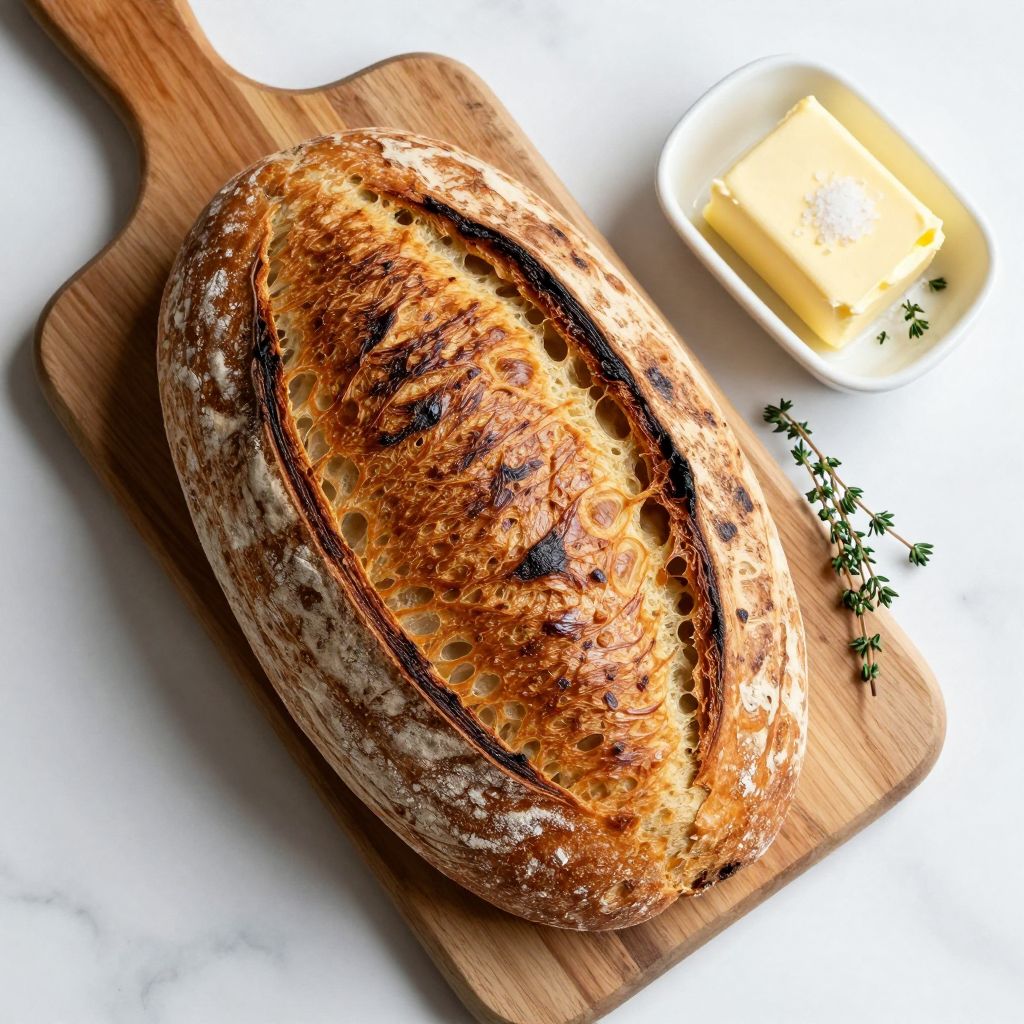
- Remove the Dutch oven lid and reduce the oven temperature to 450 degrees Fahrenheit, then bake for 25 to 30 minutes more until the loaf is deep golden brown all over.
- Transfer the loaf to a wire rack and let it cool for at least 1 hour before slicing.
Notes
Keep your sourdough starter at room temperature and feed it daily if you plan to bake weekly, or store it in the fridge and feed it once a week for occasional baking. Use a kitchen scale for all measurements for consistent results. Watch the dough, not the clock, as fermentation speed depends on room temperature. The cold overnight proof develops deep flavor and makes scoring easier.